
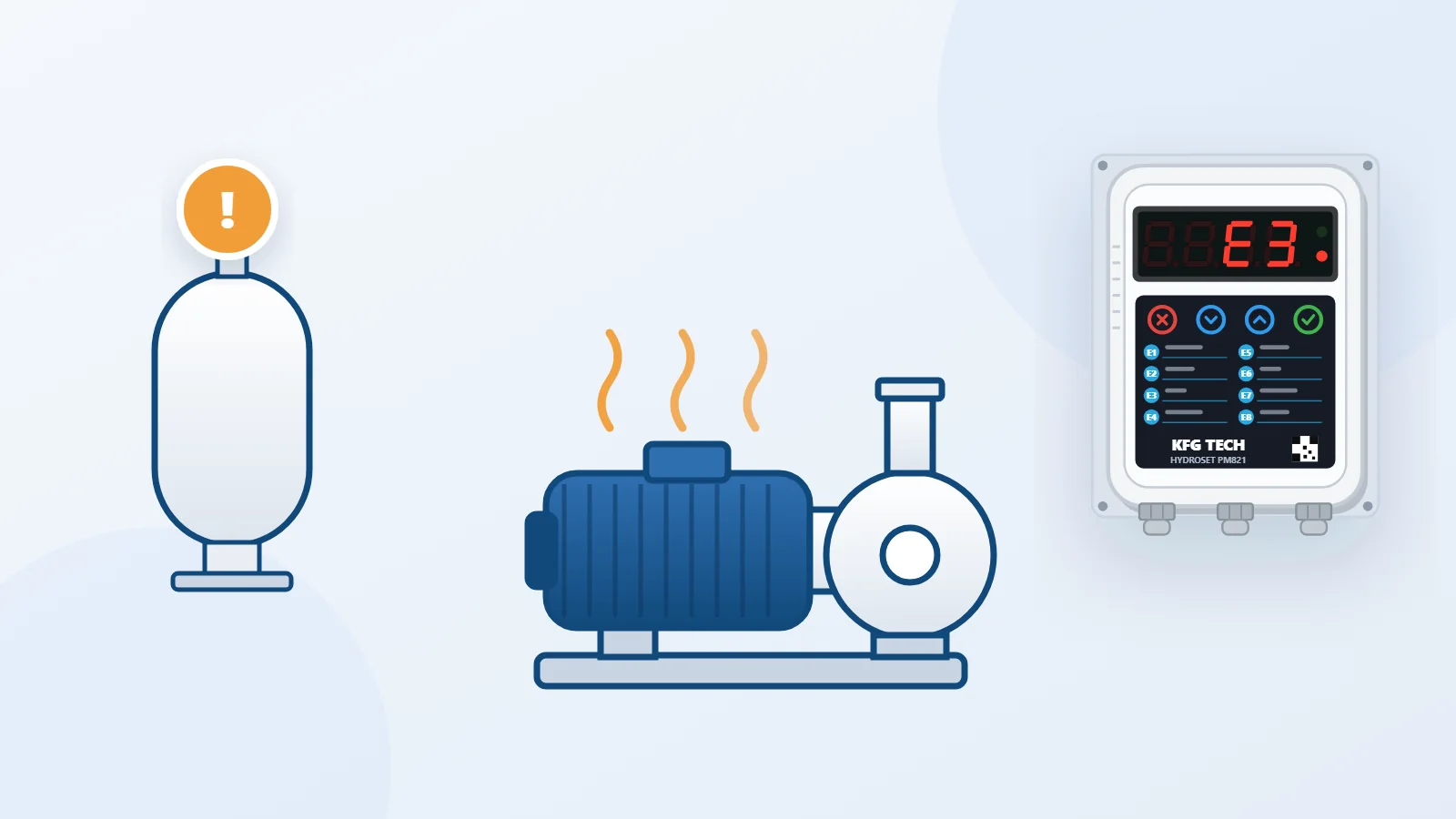
Dry running is the commonest reason a domestic pump burns out. A smart controller detects it from a drop in current (F4) or from pressure that fails to build (F10), and stops the pump.
Dry running means the pump turns without water passing through it. It is the commonest reason a domestic pump burns out. A smart pump controller detects that condition in two ways — a drop in the pump's current and pressure that fails to build — and stops the pump before damage occurs.
Why a pump burns out when it runs dry
The water passing through the pump is also what cools it. With no water, the temperature of the impeller and the seal rises, the seal burns, and the winding is damaged next. This happens in minutes, not hours.
Common causes of no water
- The mains supply is cut, or the storage tank has emptied
- The pump inlet valve is closed
- Air trapped in the pump after a repair or a drain-down
- A blocked strainer or suction line
How the unit detects it
HYDROSET PM821 has two independent methods, each with its own parameter.
| Method | Deciding parameter | Fault code |
|---|---|---|
| Drop in pump current | F4 — minimum pump current | E3 |
| Pressure fails to build | F10 — dry-run pressure threshold | E4 |
When no water reaches the pump, the current the pump draws falls. If that current drops below F4 and stays there for the F5 time, the unit stops the pump and shows E3. The factory value of F5 is 20 seconds.
The second method watches pressure: if the pressure never reaches F10, the unit reads that as dry running and shows E4. The factory value of F10 is 1.0 bar, and it must always stay below the pump's normal working pressure.
Setting F4 correctly
F4 is the most important figure here, and it is set during the initial start-up:
- Leave one tap open so the pump keeps running.
- Close the pump inlet valve and wait a moment.
- The current now on the display is the dry-running current.
- Store that figure, plus at least 0.5 A, in F4.
- Open the inlet valve again.
F4 must stay below the pump's normal working current. Set higher, the unit reads normal running as dry running and stops the pump for no reason.
It retries on its own
A dry-running fault clears by itself once the water returns. The unit retries every F6 minutes, and the factory value of F6 is 20 minutes. So if the mains supply comes back in the middle of the night, nobody has to get up and reset the unit.
When the output drives a contactor
If the unit's output drives a contactor, the pump current does not pass through the unit and detection by current does not work. In that case:
- Set F4 to 0 so E3 is ignored.
- Detect dry running by pressure instead, which means relying on F10.
Prevention without electronics
A few simple habits cut the chance of running dry:
- Keep the pump inlet valve fully open.
- Bleed the pump after every repair or drain-down.
- Clean the suction strainer periodically.
- Fit the pressure sensor after the check valve; fitted before it, the pressure reads wrong and E4 follows.
The full steps for both faults are on the E3 and E4 pages, and the permitted range of every parameter is in the user manual. If the unit's rating does not match the pump's nameplate current, the model selection guide has the matching table.