
Dry-run protection
It detects missing water two ways, by the drop in pump current and by pressure that won't build, and stops the pump before it burns out.
F4 · F10Pressure Managers are smart pump controllers for domestic water systems, easy to install and equipped with full safety features. HYDROSET holds your building's water pressure steady, starts and stops the pump gently, and is a direct replacement for the mechanical pressure switch.
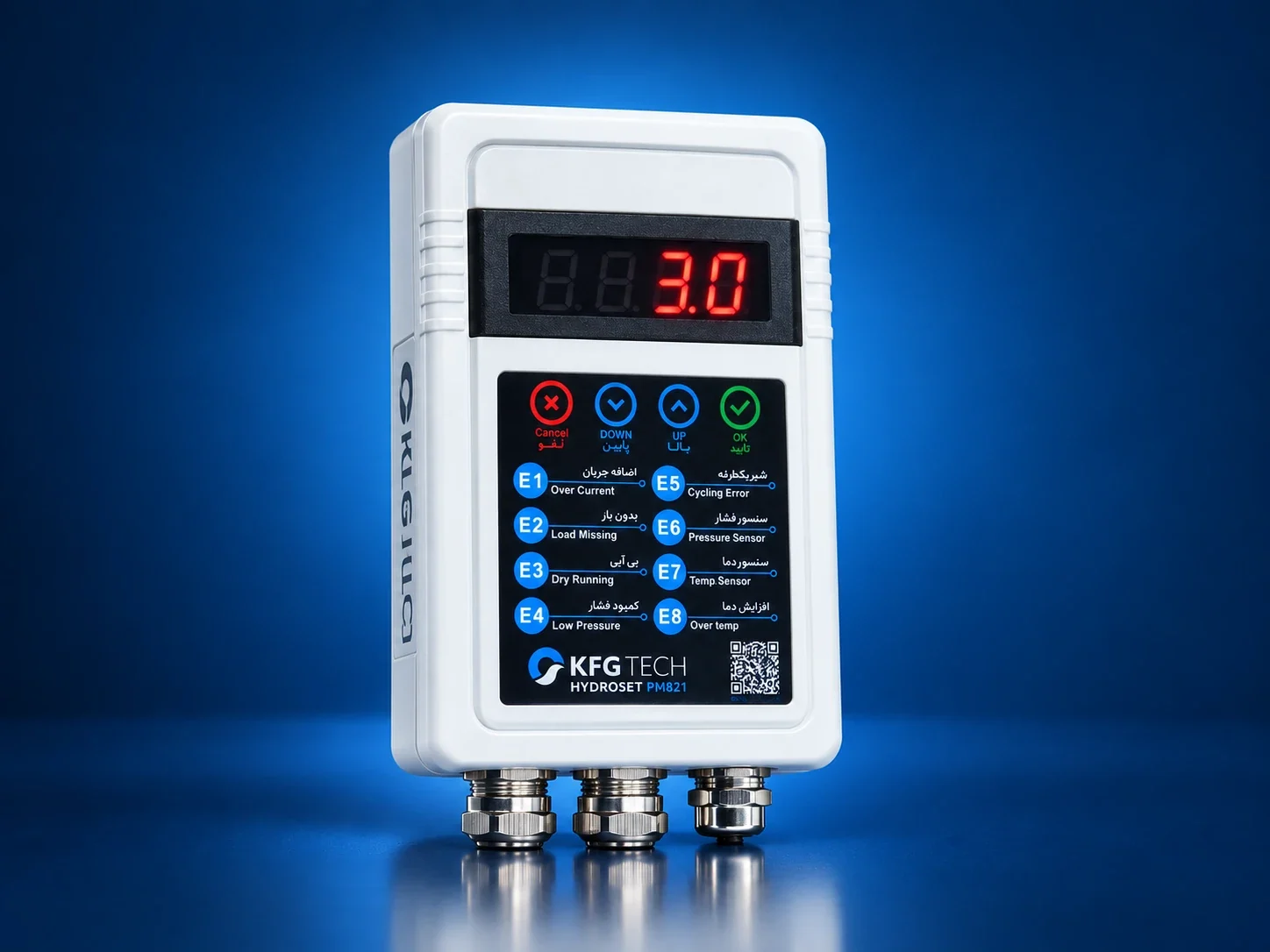
Tap the shower on any floor. The pressure drops, the controller starts the pump softly, and stops it once the showers are closed.
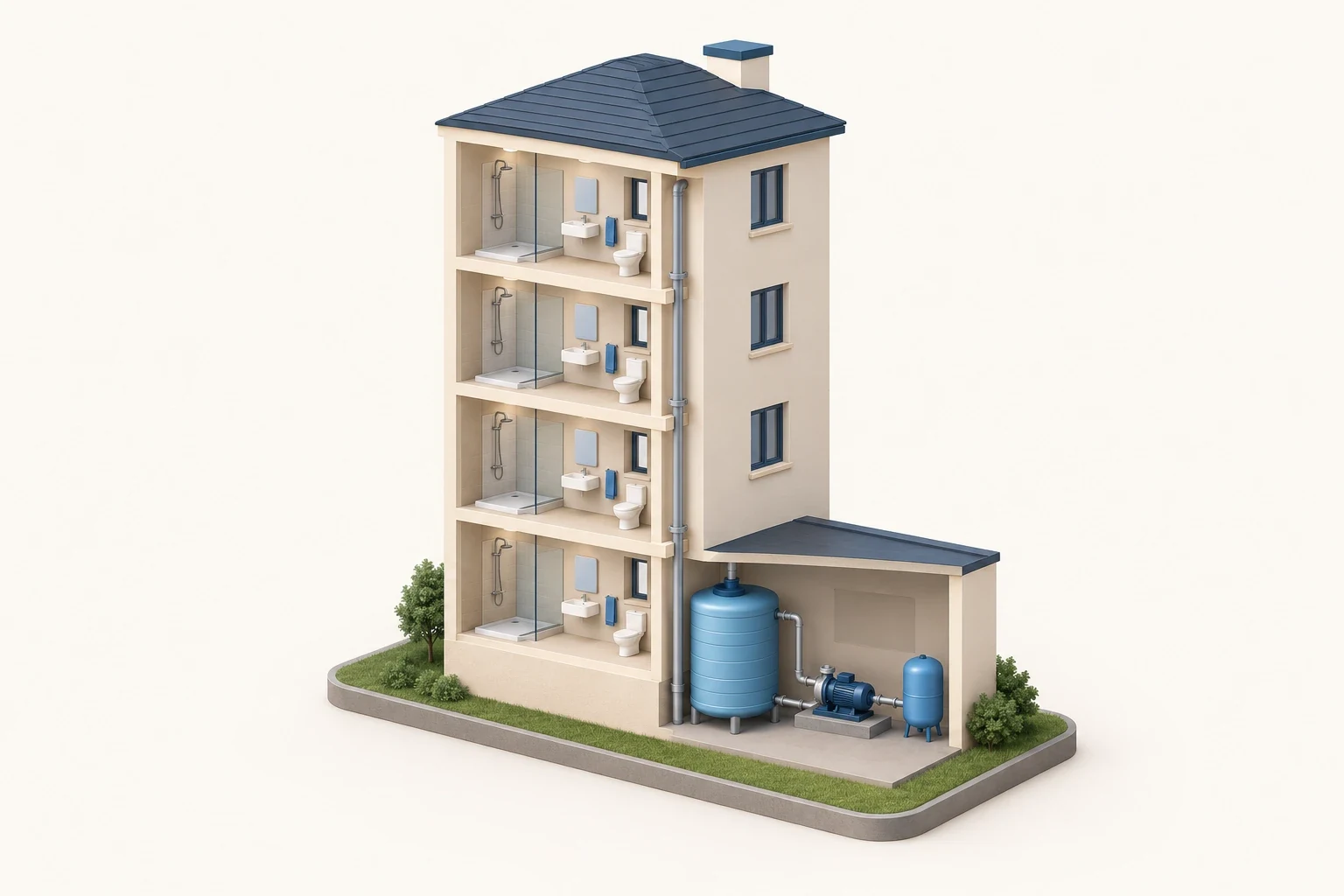
All showers are closed. The pressure holds at 3 bar and the pump is off.
Full simulator →This is a simplified demo. The full simulator, with dry-running and over-current faults, is on the How a pump controller works page.
Smart pump controller
A smart pump controller is an electronic unit that replaces the mechanical pressure switch and starts and stops the pump according to the water pressure in the pipes. Unlike a plain switch, it reads the pressure as a number through a sensor and measures the pump's current too, so it knows when the pump has run dry, draws too much current or the unit is overheating, and stops the pump before it is damaged.
HYDROSET PM821 is a smart pump controller made by Kian Faragir Vira Co. You set the start and stop pressures as numbers (F2 and F1), it ramps the pump up and down softly, shows eight fault codes on its display and can be set from a phone. The pipework stays as it is, and it works with or without a pressure tank.
| Topic | Mechanical pressure switch | HYDROSET smart controller |
|---|---|---|
| Pressure setting | Spring, approximate | Numbers on the display (F1, F2) |
| Pump start | Abrupt | Soft, timed by F11 |
| Dry running | Not detected | By current (F4) or pressure (F10) |
| Over-current | No protection | Stops above the F3 limit |
| Over-temperature | No protection | Stops and recovers on its own |
| Status display | None | Four-digit display and fault codes |
| After a water cut | Nothing | Automatic retry every F6 minutes |
Why HYDROSET
One small unit in place of the mechanical pressure switch: it holds the pressure steady and protects the pump from dry running, over-current and water hammer.
It detects missing water two ways, by the drop in pump current and by pressure that won't build, and stops the pump before it burns out.
F4 · F10If the pump current rises above the set limit, the pump stops and E1 appears on the display.
F3 · E1The pump ramps up and down gently, so there is less water hammer in the pipes.
F11 · F12The start and stop pressures are numbers you read on the display, not a spring and a screw.
F1 · F2Every fault has a code, E1 to E8, with its cause and fix in the manual and on this site.
E1 – E8After a water cut the unit tries the pump again on its own; nobody has to reset it.
F6Every setting through a Bluetooth app on an Android phone, even in a pump room with no internet.
BluetoothIt fits where the pressure switch was, with no pipework changes, and works with or without a pressure tank.
Easy installModels
All three share one core and differ only in the maximum pump current. The only number you need is the current on your pump's nameplate.
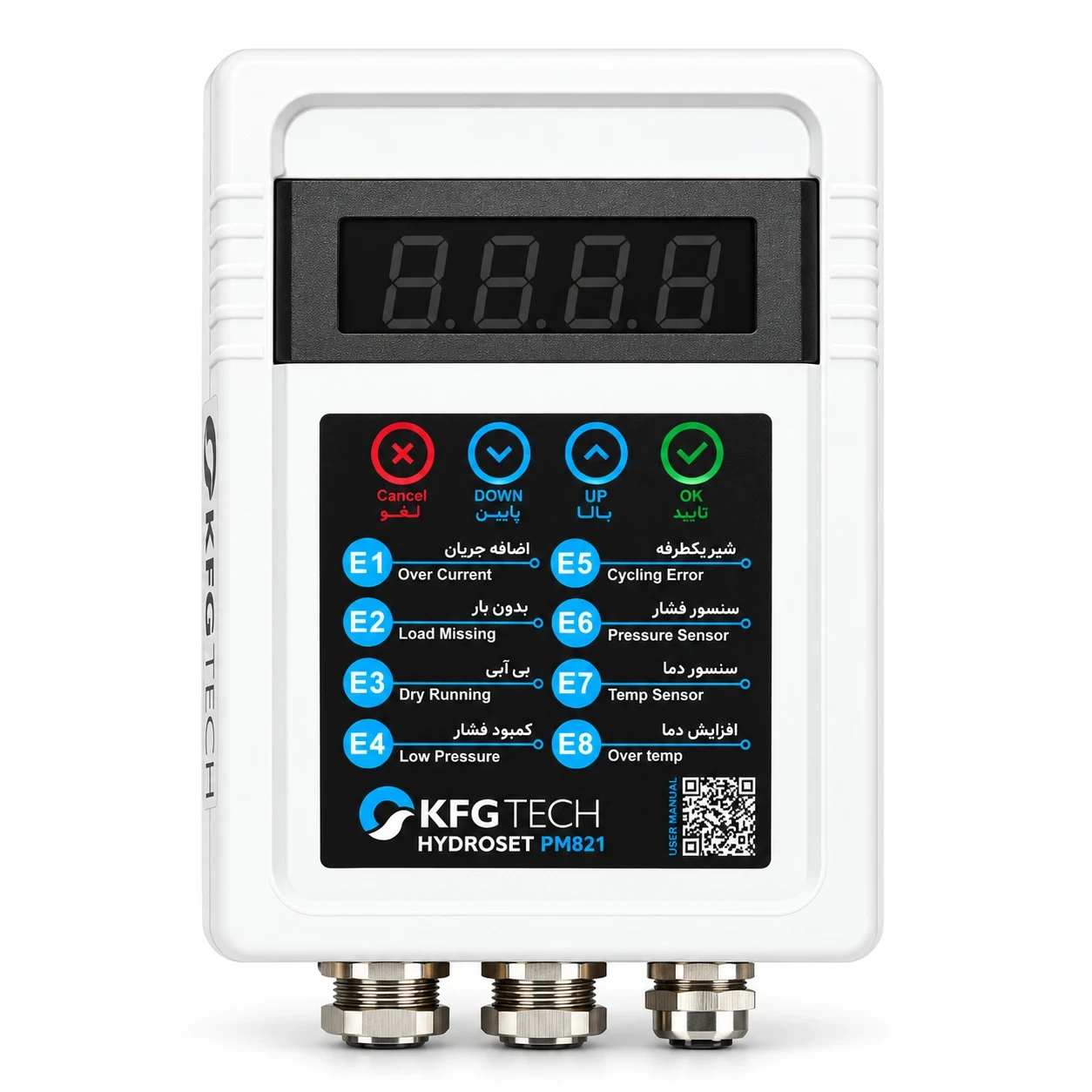
HYDROSET
1–4 floors, homes and shops
Who it's for
Steady shower pressure, a pump that won't burn out when the water stops, and a fit in place of the old pressure switch.
No pipework changes, F1 to F15 set in numbers, and fault codes for quick troubleshooting.
Enough pressure on the upper floors, fewer pump starts and a clear code for every fault.
HYDROSET does not depend on the pump brand. Any single-phase water pump whose current falls within the range of the chosen model will work with it — a domestic peripheral pump, a jet pump, or a multistage pump in a building booster set. It takes the place of the mechanical pressure switch, so you do not need to change the pipework or the pump.
This list is only a compatibility guide. KFGTECH is not a dealer for these brands and does not sell them; we manufacture the smart pump controller. The only figure that matters when choosing a model is the current on your pump's nameplate.
With a pressure vessel
and without one — it works either way.
In a building booster set
to hold line pressure steady and protect the pump.
Homes, shops and gardens
from a single unit to multi-storey buildings.
Buying a pump controller is not complicated. All we need is your pump current, or the number of floors and units in the building, and we will pick the right model together.
Call the factory or send your request through the contact form.
We suggest the correct model from the nameplate current, or the number of floors and units.
Current pricing and terms for end users, dealers and sales partners.
Once confirmed, the order is packed and shipped nationwide.
The unit ships ready to run on factory settings, with a manual and phone support.
A 3-year replacement warranty, then 4 years with a new unit at 20% off.
Tell us the current on the pump nameplate or the number of floors and we'll suggest the right model.
Controller
PM821-8
Pump
1–1.5 hp
head over 32 m
Pressure tank
80–100 L
pre-charge about 1.5 bar
An estimate for typical residential buildings, about 3 m per floor.
An electronic unit that replaces the mechanical pressure switch and starts and stops the pump by water pressure; it reads the pressure as a number, measures the pump current and stops the pump on dry running, over-current or overheating.
The current on the pump nameplate decides: up to 8 A is the PM821-8, 8 to 16 A the PM821-16, and up to 25 A the PM821-25.
Yes. The controller works with or without a pressure tank; the tank only means the pump starts less often for small draws.
The unit detects it from the drop in pump current or from pressure that won't build, stops the pump and tries again every F6 minutes. The factory value of F6 is 20 minutes.
No. The pressure sensor goes where the pressure switch was, after the check valve, and the pump's power runs through the unit's output.
A 3-year replacement warranty (warranty sticker intact); for 4 years after that, a new unit at 20% off the current price.