
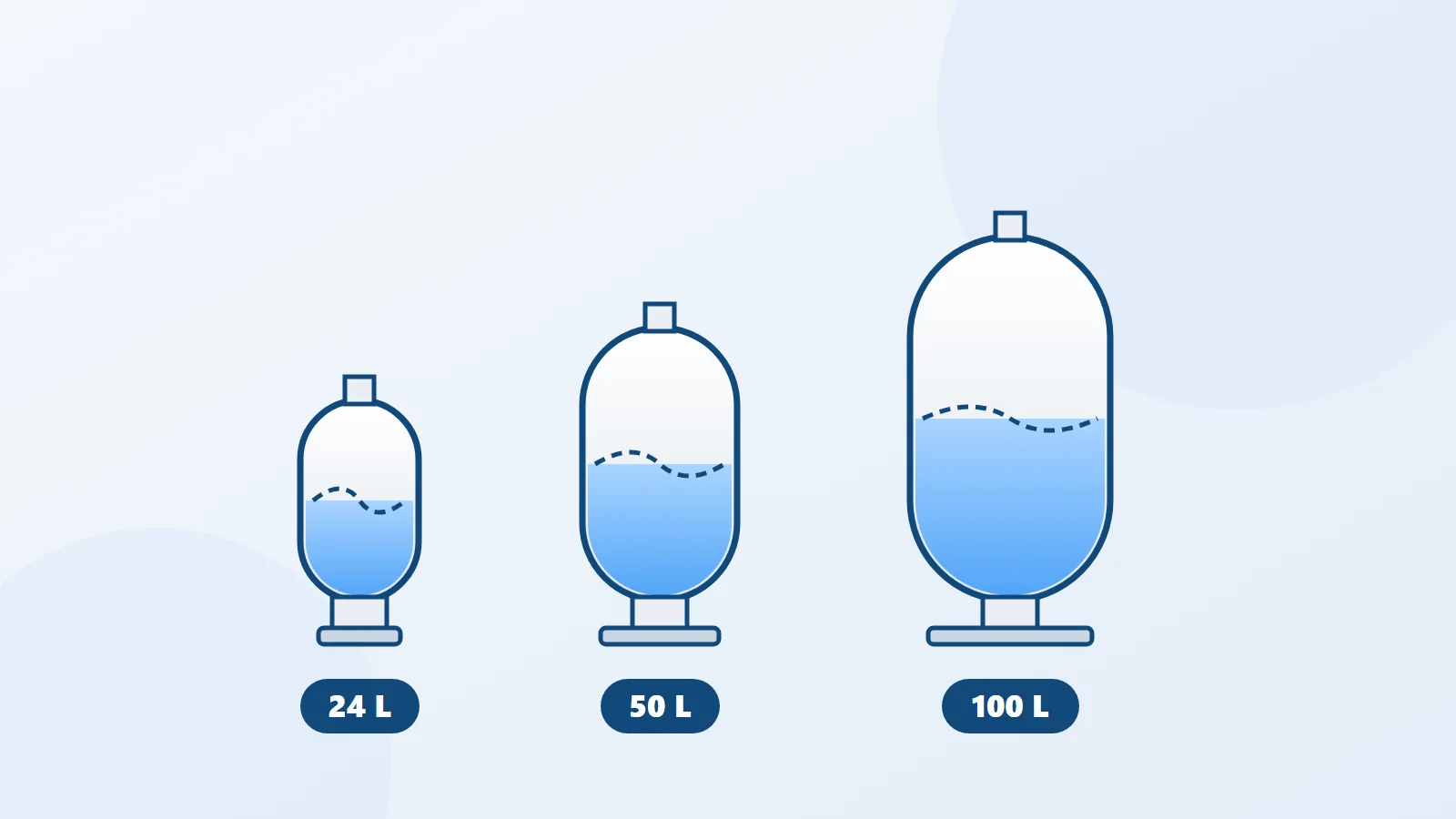
How a pressure vessel stops the pump short-cycling, what volume suits your building, and whether you still need one alongside a smart controller.
The pressure vessel is one of the most misunderstood parts of a building's water system. Many people are unsure what it actually does and whether it is still needed once a controller is fitted.
What a pressure vessel does
Inside the vessel there is a rubber bladder and a volume of compressed air. When the pump runs, water enters the bladder and compresses the air further. When a tap opens, that compressed air pushes the water out — without the pump having to start.
The result is simple: the pump does not start for every small draw, such as opening a tap for a few seconds.
Why that matters
Every start draws a high inrush current and stresses the motor, the capacitor and the pressure switch. If the pump starts and stops dozens of times an hour, its life shortens sharply. In the trade this is called short cycling.
A pressure vessel reduces how often the pump starts; a controller reduces how hard each start is. The two complement each other rather than replace one another.
What size to choose
Volume depends on pump flow and how the building uses water. In typical residential buildings the number of units decides the vessel volume:
| Units in the building | Common vessel volume |
|---|---|
| 1 to 2 units | 24 litres |
| 3 to 6 units | 50 litres |
| 7 to 10 units | 80 to 100 litres |
| more than 10 units | 150 litres and above |
These figures are estimates based on common installations. Larger projects need a proper calculation from flow and the cut-in/cut-out pressure difference.
Pressure vessel size by number of floors
The table below gives the vessel size for buildings of 2 to 10 floors in two cases: one unit per floor and two units per floor. The number of floors decides the typical pump; the number of units decides the vessel volume. The air pre-charge is about 0.2 bar below the pump's start pressure (F2), with F2 worked out from about 3 m per floor.
| Building | Typical pump | Vessel, 1 unit per floor | Vessel, 2 units per floor | Pre-charge |
|---|---|---|---|---|
| 2 floors | 0.5–1 hp | 24 litres | 50 litres | 0.9 bar |
| 3 floors | 1–1.5 hp | 50 litres | 50 litres | 1.2 bar |
| 4 floors | 1–1.5 hp | 50 litres | 80 to 100 litres | 1.5 bar |
| 5 floors | 2 hp | 50 litres | 80 to 100 litres | 1.8 bar |
| 6 floors | 2 hp | 50 litres | 150 litres and above | 2.1 bar |
| 7 floors | 2.5 hp | 80 to 100 litres | 150 litres and above | 2.4 bar |
| 8 floors | 2.5 hp | 80 to 100 litres | 150 litres and above | 2.7 bar |
| 9 floors | 3 hp | 80 to 100 litres | 150 litres and above | 3.0 bar |
| 10 floors | 3 hp | 80 to 100 litres | 150 litres and above | 3.3 bar |
Pressure vessel for a 3-storey building: a 50-litre vessel is typical whether there is one unit per floor or two. The pre-charge is about 1.2 bar.
Pressure vessel for a 4-storey building: with one unit per floor a 50-litre vessel, with two units per floor 80 to 100 litres. The pre-charge is about 1.5 bar.
Pressure vessel for a 5-storey building: with one unit per floor a 50-litre vessel, with two units per floor 80 to 100 litres. The pre-charge is about 1.8 bar.
Pressure vessel for a 1 hp pump: a 1–1.5 hp pump usually serves a 3- to 4-storey building, and a 50 litre vessel is typical with it; if the building has more than 6 units, an 80 to 100 litre vessel is better.
If your building does not fit the table, enter its floors and units in the building equipment calculator to see the vessel size, pump, controller model and the F1 and F2 settings together. Setting the pre-charge is covered in pressure vessel pre-charge.
Do you still need one with a controller?
HYDROSET works both with and without a pressure vessel. Without one, it still steadies the pressure and starts the pump gently. But a vessel reduces how often the pump starts, and in high-demand buildings that makes a noticeable difference to pump life.
- Have a vessel? Add a controller for steady pressure and a protected pump.
- No vessel? A controller works on its own; you can add a vessel later.
Signs of a failed pressure vessel
A vessel that has lost its air or has a torn bladder no longer stores water, and the pump works harder. Take these signs seriously:
- The pump starts for every small draw, even a tap opened for a few seconds, and keeps starting and stopping.
- The vessel's air pressure is below what it should be, or falls again after you top it up.
- Pressing the vessel's air valve lets out water instead of air, which means the bladder is torn.
- The vessel body leaks or is rusting.
A bladder has no fixed lifespan; it depends on its quality, the working pressure and how often the pump starts. The best defence is catching a failure early: check the vessel's air pressure once a year. If the bladder is torn, the bladder or the whole vessel is replaced, depending on the vessel type.
Maintenance notes
- Check the vessel's air pressure once a year. It should normally sit slightly below the pump's cut-in pressure.
- If the pump suddenly starts short cycling, the first things to check are the air pressure and the bladder.
- Install the vessel where it can be inspected and drained.
To choose a model by the pump's nameplate current, see the model selection guide.