
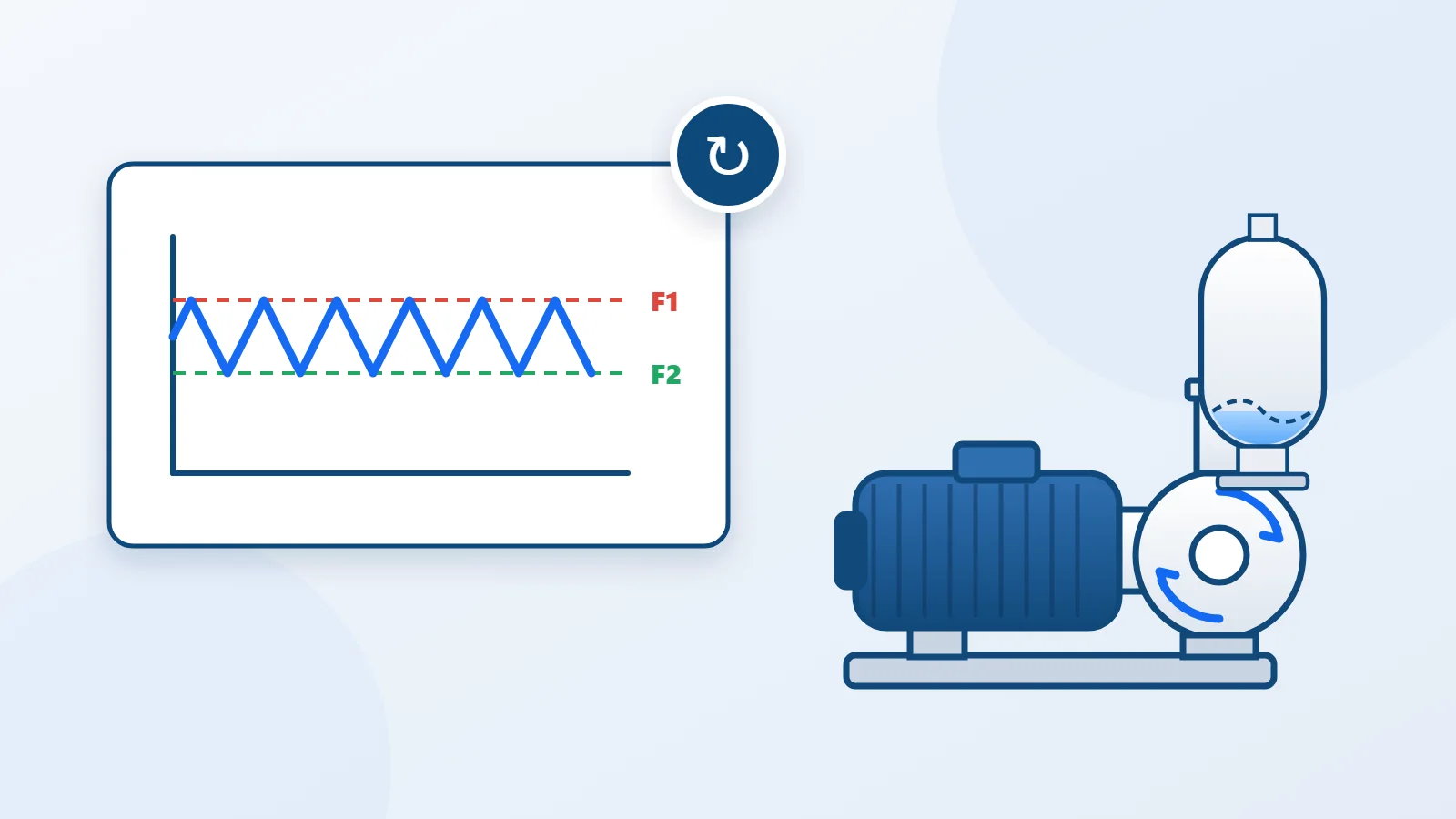
Short cycling has three common causes: too small a gap between F1 and F2, lost air pressure in the vessel, and a leaking check valve. How to tell which one it is, in order.
When a water pump starts and stops repeatedly with no tap open, that is called short cycling. It has three common causes: too small a gap between the start and stop pressures, lost air pressure in the pressure vessel, and a leak in the check valve or the pipework. All three can be identified, and the order to check them is below.
Why short cycling matters
Every start draws a large inrush current. On PM821-8 that peak reaches 10 A and on PM821-16 it reaches 30 A, while the same pump's normal running current is far lower. Repeating that inrush often wears out the pump's switch and capacitor early.
First cause: too small a gap between F1 and F2
Parameter F1 is the pump stop pressure and F2 is the pump start pressure. If the two figures sit close together, the smallest pressure drop starts the pump and it stops again immediately.
The HYDROSET PM821 manual gives 1 to 1.5 bar as the suitable gap between F1 and F2. The factory values follow it: F1 at 3.0 bar and F2 at 1.5 bar.
- Enter the settings with the Confirm key and read F1 and F2.
- If the gap is under 1 bar, lower F2 until the gap is 1 to 1.5 bar.
- F2 must always be lower than F1.
Second cause: air pressure in the vessel
If the building has a pressure vessel, the air pressure inside it must sit a little below the pump start pressure (F2). When that air escapes, or the bladder inside splits, the vessel no longer stores water and the pump starts for the smallest draw.
- Measure the vessel's air pressure with a tyre gauge.
- If the air is low, pump it up to just below the F2 value.
- If it does not hold air, the bladder has split and the vessel needs replacing.
If a pump suddenly starts short cycling with no change to the settings, the first things to check are the vessel's air pressure and whether its bladder is intact. There is more in the pressure vessel guide.
Third cause: a leak in the check valve or the pipework
If the check valve leaks, water flows back from the pressure side, the line pressure falls and the pump starts again. A leak in the pipework or the bypass valve does the same.
The test is simple:
- Close every tap in the building.
- Note the pressure on the unit's display.
- Wait a few minutes and read it again.
If the pressure falls with nothing drawing water, something is leaking. Check the bypass valve too — it may look closed but still leak.
How often should a pump start?
There is no fixed figure. A pump should start only when water is being drawn in the building and the pressure has fallen to F2. So the right test is:
- With no tap open, the pump should not start. If it starts and stops every few minutes like this, one of the three causes above is at work — most often a leak (the third cause).
- For a short draw, such as opening a tap for a few seconds, a building with a sound pressure vessel usually does not start the pump; the vessel supplies it from its stored water.
- For a long draw, such as a shower, the pump should stay on or start and stop at long intervals. If it still starts and stops in quick succession, check the F1–F2 gap first (the first cause) and then the vessel's air pressure (the second).
If the pump never stops at all
This is a different problem from short cycling. If the pump keeps running and never stops, it is not reaching the F1 pressure. The manual gives a simple rule: the pump head on the nameplate must exceed the building height plus 20 m. A pump weaker than that never reaches F1.
The order to check
| Order | What to check | Sign |
|---|---|---|
| 1 | Gap between F1 and F2 | under 1 bar |
| 2 | Vessel air pressure | low air or split bladder |
| 3 | Check valve or pipe leak | pressure falls with taps closed |
| 4 | Pump capacity | the pump never stops |
If the unit shows a fault code alongside the cycling, the list of fault codes gives the cause of all eight. Every parameter and its permitted range is in the user manual.