
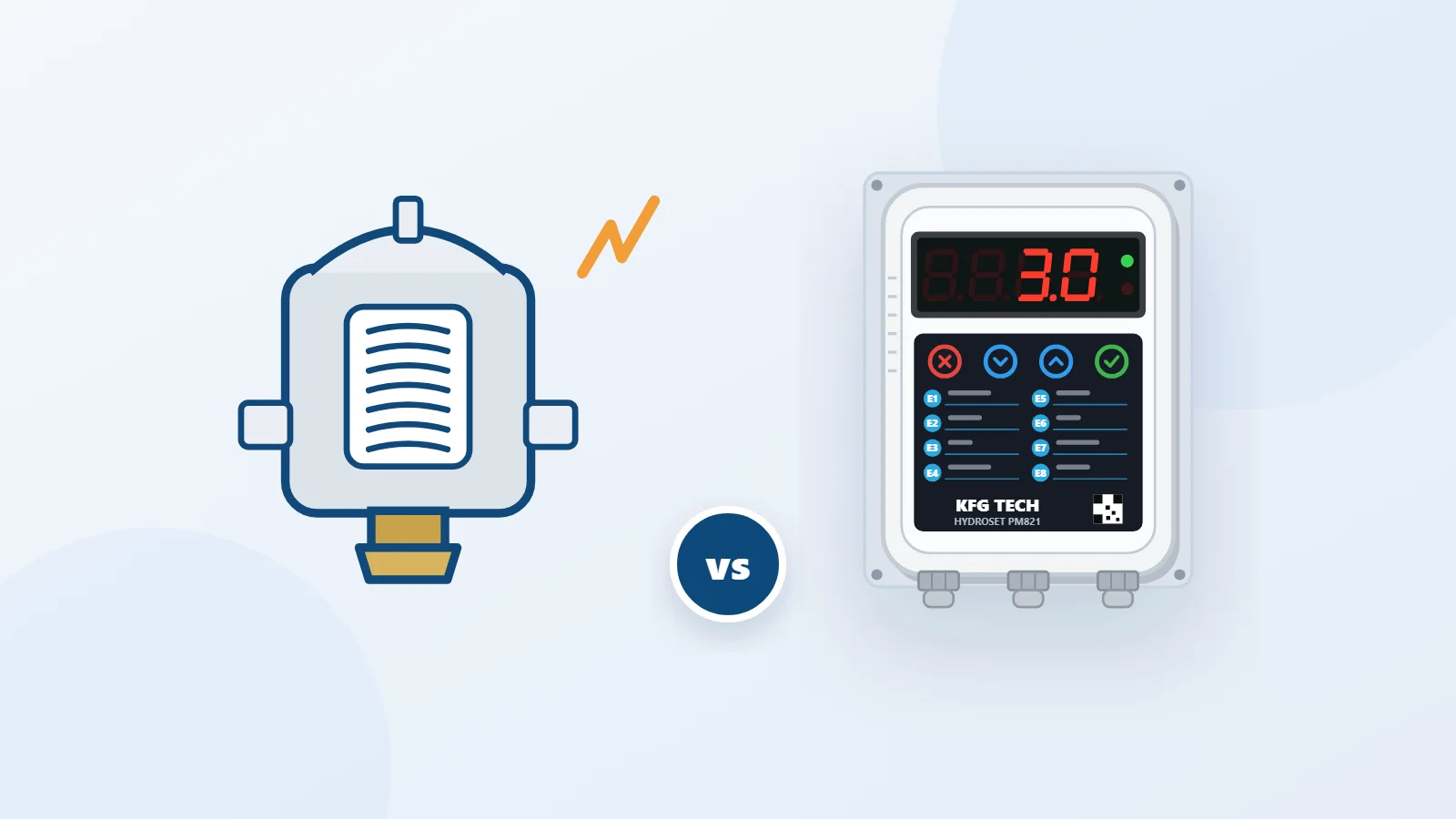
A mechanical pressure switch only makes and breaks a contact. What changes when you replace it with a pump controller, and how the swap is done.
In most buildings a mechanical pressure switch still decides when the pump runs. It is cheap and simple, but what it does is not quite what a domestic water system needs.
What a mechanical pressure switch does
A spring and a diaphragm make and break a contact at a set pressure. That is all. The device does not know how much current the pump draws, whether water is reaching it, or how hot it has become.
In practice that means:
- The pump starts abruptly at full power and creates water hammer in the pipework.
- If the water runs out, the pump runs dry until it burns.
- Pressure noticeably fluctuates on the upper floors.
- Pressure is set with a screw and a spring, which is not precise.
What a pump controller changes
An electronic controller measures line pressure continuously and decides accordingly. Besides pressure it also reads the pump current and its own temperature, so it can start the pump gently and stop it on dry running, over current and overheating. The full feature-by-feature table is in pump controller vs pressure switch.
Why soft starting matters
When a pump starts suddenly, the column of water in the pipe accelerates and water hammer follows. Over time that loosens fittings, wears valves and stresses the pump itself. Soft starting spreads that acceleration out.
On HYDROSET the soft-start and soft-stop times are set with parameters F11 and F12.
Dry-run protection
The commonest reason a domestic pump burns out is running without water. A smart controller detects that in two ways: a drop in the pump's current, and pressure that fails to build. In either case the pump is stopped and the unit retries at the interval you set.
Replacing the pressure switch, step by step
The swap needs no pipework change; the controller takes the pressure switch's place directly.
- Switch off the pump's power.
- Unscrew the pressure switch from the five-way manifold and fit the pressure sensor in its place. The sensor must sit after the check valve.
- In the old wiring the pump's power ran through the pressure switch. Now the pump cable goes to the unit's output terminal and the mains to its input terminal; the details are in pump controller wiring.
- Power the unit and set F1 and F2. Factory settings suit most installations; the full method is in setting a pump controller.
Choose the model from the pump's nameplate current: PM821-8 up to 8 A, PM821-16 up to 16 A.