The pump is on and making a noise, but no water comes up. Five common causes, from an air-locked pump to the foot valve, and what the pump controller does in this situation.
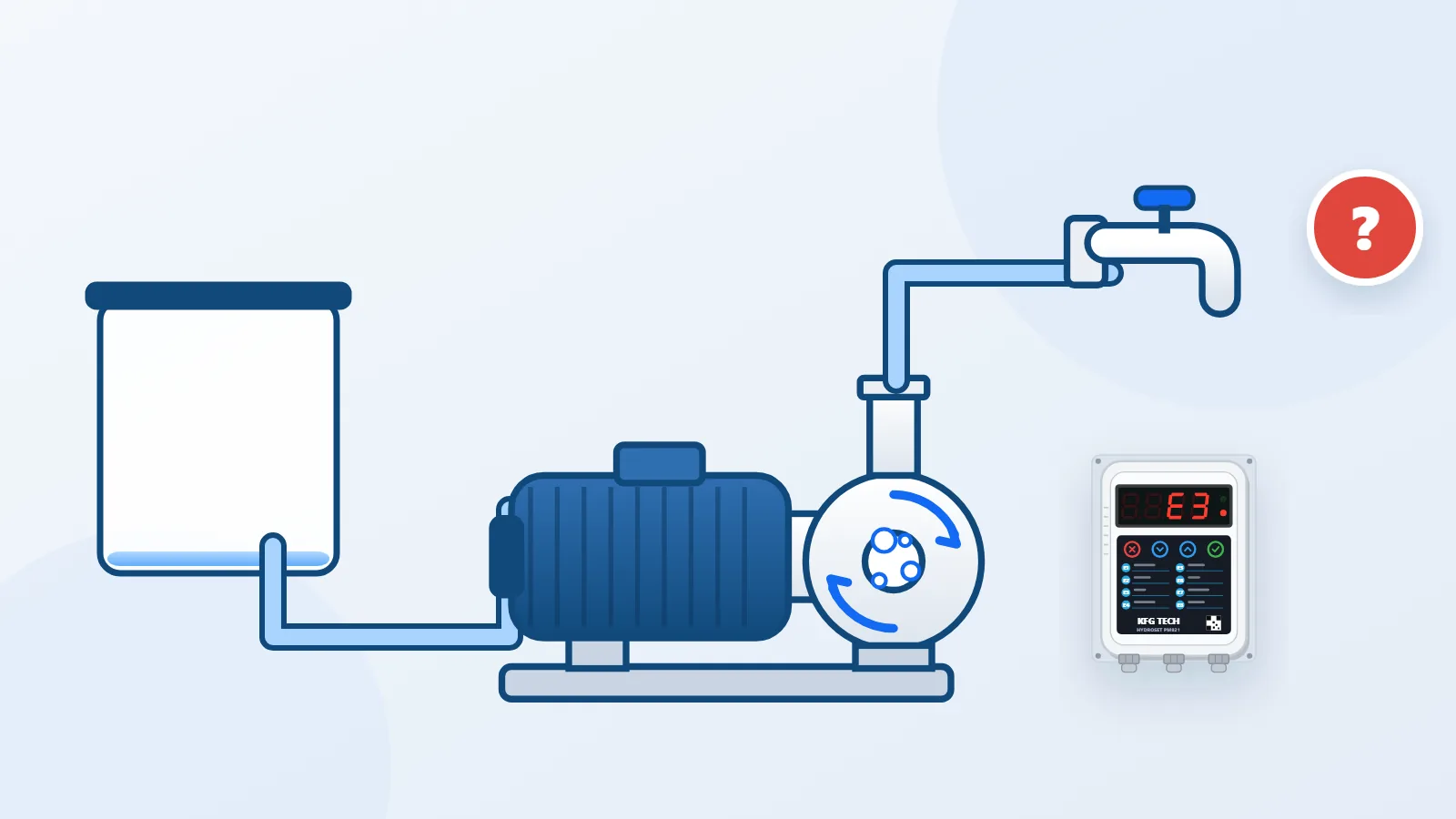
A pump that is on and sounds as if it is working but gets no water to the taps is different from a pump that won't start at all. Here the motor is fine and turning; the problem is in the water's path. Take this seriously: a pump that turns without water heats up quickly and gets damaged.
First, see what the unit shows
If the building has a HYDROSET pump controller, the unit detects this condition itself and switches the pump off. Two fault codes relate to it:
| Code | How the unit knows | Meaning |
|---|---|---|
| E3 | Pump current has fallen below F4 | The pump is running unloaded; no water is reaching it |
| E4 | Pressure has not risen above F10 | The pump is running but building no pressure |
The no-water detection time is set by F5 (factory setting 20 seconds), and after a fault the unit tries again every F6 minutes (factory setting 20 minutes). So if E3 or E4 is on the display, the pump has been saved from dry running and now you need to find the cause.
Cause 1: the pump is air-locked
This is the most common cause. When there is air instead of water inside the pump and the suction pipe, the impeller turns but moves no water. It happens a lot after the pipes have been drained, after a repair or after a long water cut. The fix is to prime the pump.
Cause 2: water isn't reaching the pump inlet
- The storage tank is empty, or its water level has dropped below the mouth of the suction pipe.
- The pump inlet valve is closed or half open.
- The inlet strainer is blocked.
In this case priming only helps until the water runs out again. If the tank empties quickly, see float switch or dry-run protection.
Cause 3: the foot valve or check valve doesn't hold
When the pump sits above the water level, the suction pipe must always stay full. If the foot valve or the check valve on the suction line leaks, the water flows back after every stop and the pump starts empty the next time. The sign is that the pump works after priming but no longer draws water after standing for a few hours.
Cause 4: air is getting in at the suction pipe joints
On the suction side the pressure inside the pipe is lower than outside; so instead of water spurting out of a loose joint, air is drawn in and you see no trace of a leak. Tighten the suction pipe joints and clamps and check the sealing on the threads.
Cause 5: the pump type doesn't suit where it is installed
A pump that has to draw water from a tank or well lower than itself must be self-priming, such as a jet pump. A peripheral pump is for when the tank is level with or higher than the pump. If you have installed a peripheral pump above the water level, it may take in air after every stop. The building equipment calculator suggests the pump type based on where the tank is.
Order of checks
| Order | What to check | Sign |
|---|---|---|
| 1 | Tank water level and inlet valve | Empty tank or closed valve |
| 2 | Air inside the pump | Fixed by priming |
| 3 | Foot valve and check valve | Takes in air again after every stop |
| 4 | Suction pipe joints | Bubbles in the outlet water, irregular running |
| 5 | Pump type | Peripheral pump above the water level |
If all of this is fine and the unit still gives E3, F4 may be close to the pump's normal working current. The manual says to lower F4 a little in this case; the right way to measure it is in installing a pump controller.