A pump fitted straight after the meter is left without water every time the mains supply drops. The risks, how the pump controller helps and what the settings should be.
In searches, "without a tank" means two things, and we answer both here: a pump with no storage tank that draws straight from the mains pipe after the meter; and a system with no pressure vessel.
A pump straight after the meter
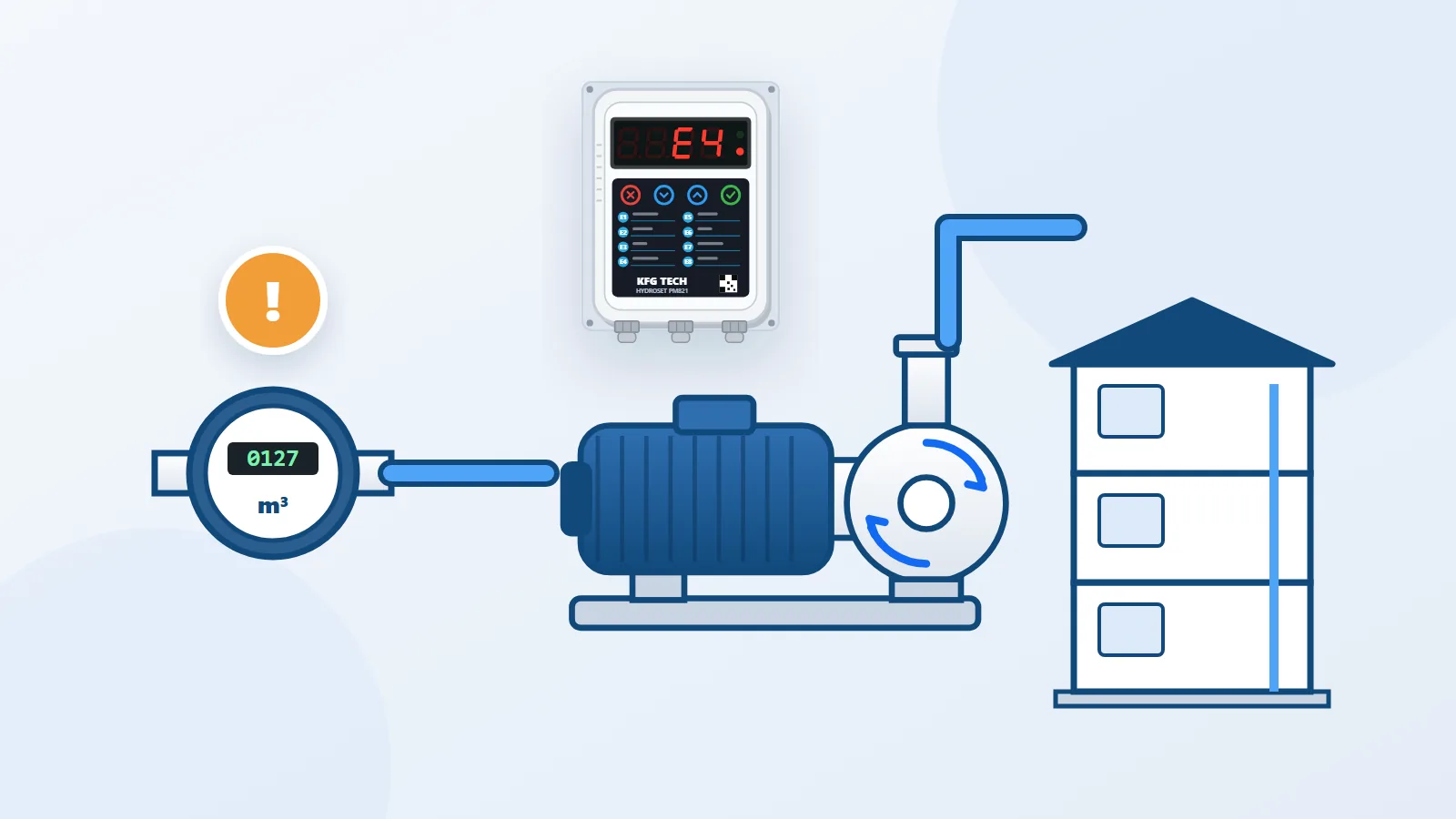
In this setup the pump draws water from the mains connection and supplies it to the building. It is simpler and cheaper to install, but it has two serious drawbacks:
- The pump depends on the mains supply. Whenever the network pressure or flow drops, or the water is cut off, the pump has no water to draw and runs dry.
- It may not be permitted. Pumping directly from the mains connection affects the network pressure and the neighbours, and the water and wastewater company may not allow it. Before installing, ask your local water and wastewater company about its rules.
If you can, fit a storage tank: the mains fills the tank and the pump draws from the tank. That way short mains cuts are not felt in the building either.
With a direct connection, dry-run protection is essential
In this setup dry running is not an accident; it happens again with every drop in the mains supply, and dry running is the most common reason domestic pumps burn out. In this case the HYDROSET pump controller does three things:
- When no water arrives, it detects this from a drop in current (below F4) or from the pressure failing to rise (below F10), and switches the pump off.
- It shows fault E3 or E4 so you know the problem is the water, not the pump.
- It tries again every F6 minutes. When the water comes back, the fault clears itself and the system runs again without you doing anything.
Settings for an installation without a storage tank
| Parameter | Function | Factory setting | Note for this installation |
|---|---|---|---|
| F4 | Minimum pump current | 1.0 A | A little above the pump's no-water current and below its normal working current |
| F5 | No-water detection time | 20 seconds | Don't increase it, so the pump spends less time running dry |
| F6 | Retry time | 20 minutes | If the mains water comes back quickly, you can reduce it |
| F10 | No-water detection pressure | 1.0 bar | Must be below the pump's normal working pressure |
Know one normal behaviour too: if the mains pressure on its own is above F2, the pump does not start; the pump only runs when the network pressure is not enough for the building. The right F1 and F2 for your building height are in How many bar of water pressure does a building need?
A system without a pressure vessel
A pressure vessel is different from a storage tank: the tank stores water for the pump, while a pressure vessel holds some water under pressure so the pump doesn't start for every small draw. HYDROSET works both with a pressure vessel and without one. Without a vessel:
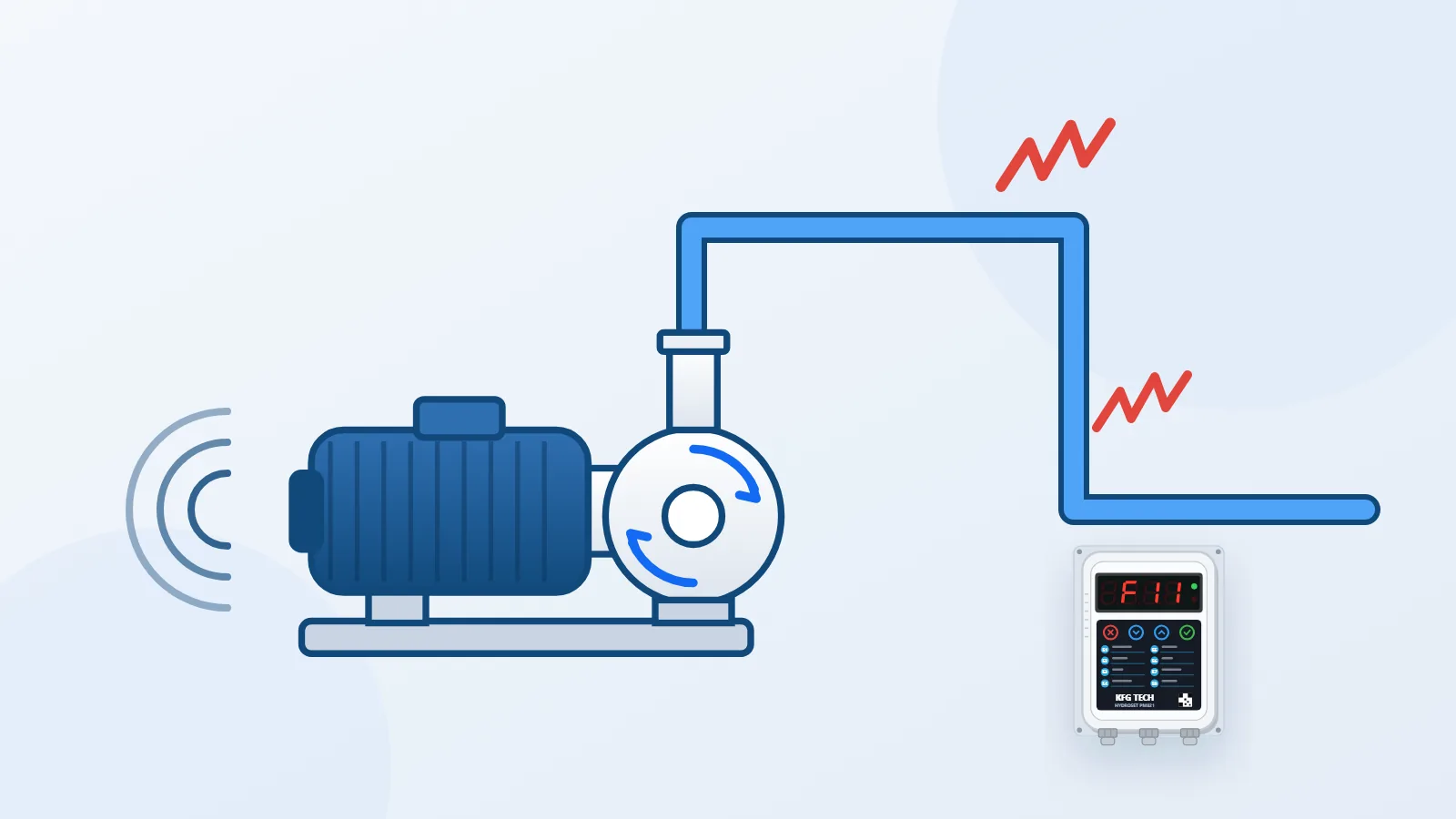
- The pump starts for every draw, even a tap opened briefly. Soft start and soft stop (F11 and F12) reduce the strain these starts put on the pump and the pipes.
- Keep the gap between F1 and F2 within the 1 to 1.5 bar the manual recommends, so the pump doesn't keep switching on and off.
- If you want to add a vessel later, pressure vessels gives the right size for each number of floors.
Choose the controller model from the pump nameplate current: PM821-8 up to 8 A and PM821-16 up to 16 A.